Drayage
Chassis Split Fees in Drayage: What They Cost and How to Quote Them
A chassis split is the extra trip a driver makes when the container and its chassis are in different places. What carriers publish for it, why the ranges online disagree, and how to put it on a quote.
 Sam Kabab6 min read
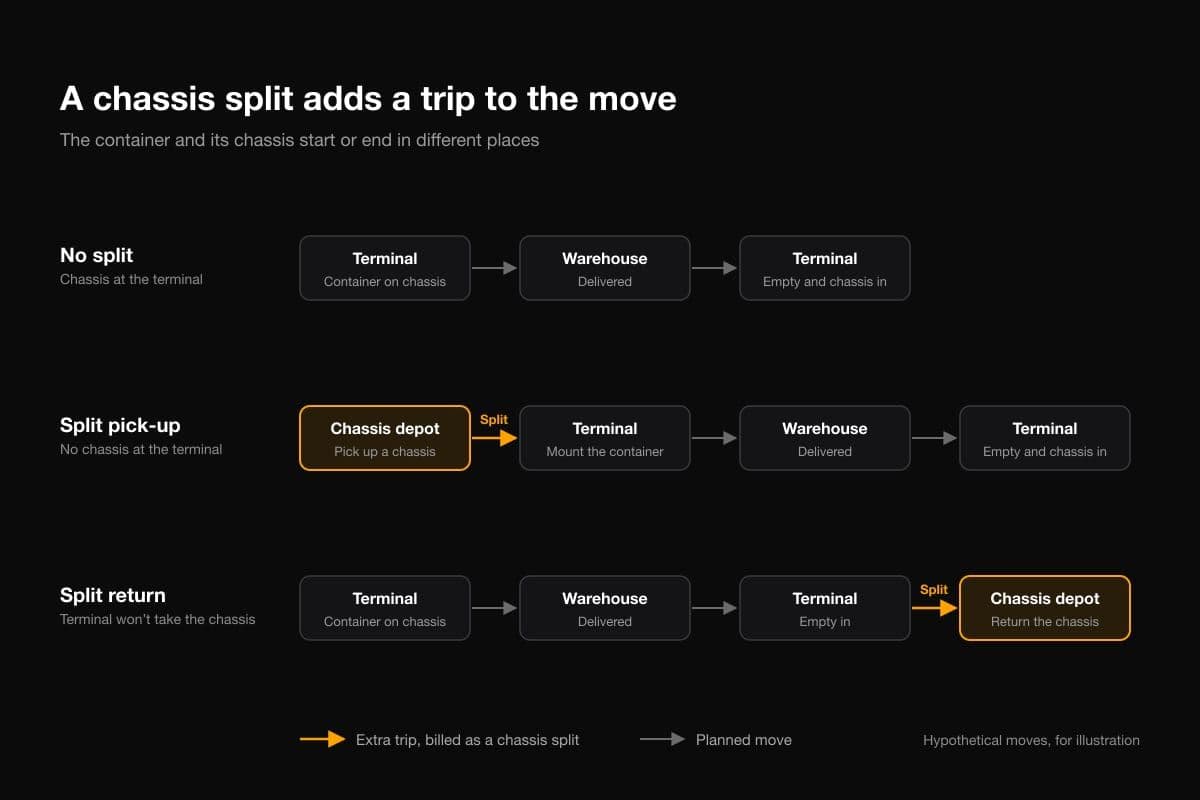
A driver arrives at a Chicago rail ramp for a container, but there are no chassis at the ramp. The driver goes to a depot down the road, picks up a chassis, comes back and mounts the container. That extra trip is a chassis split, and the carrier bills it on top of the line haul. In its May 2026 drayage update, C.H. Robinson reported splits rising across the Chicago ramps.
Search for the fee and you will find ranges anywhere from $25 to $400. This guide uses carriers' own published schedules instead, explains why splits happen, and shows how to quote them.
What a chassis split is
A chassis split is an extra trip because the container and its chassis are in different places. There are two kinds, and one move can have both:
- Split pick-up: the terminal or ramp has no chassis for the container, so the driver first picks one up at a pool or depot.
- Split return: the terminal won't take the chassis back with the empty container, so the driver returns it to a depot somewhere else.
Carriers bill it as a flat charge per split, for the extra time and miles. Because a move can have one at each end, schedules often allow up to two: Rhenus says splits are normally two per move, and Easley Transportation charges up to two. Some carriers list a split as an extra pick-up or drop rather than by name.
Why splits happen
- Rail ramps without chassis on site: ramps often keep chassis at depots outside the ramp, so splits are more common there than at marine terminals with a chassis pool on the terminal.
- Chassis that can't be swapped: a chassis from one pool or provider can't always stand in for another, so the driver has to fetch the right one.
- Special chassis: tri-axle chassis for heavy 20-foot containers are kept at fewer depots, so ordering one can cause a split on its own.
- Returns the terminal won't accept: when the empty goes back to one place and the chassis to another, the return is split.
Los Angeles and Long Beach show how pools shape this. DCLI, Flexi-Van and TRAC chassis there have been interchangeable in a shared "pool of pools" since March 2015, as Transport Topics reported. But DCLI said in 2020 that about a third of moves there use chassis outside that pool, which can't be swapped with it (FreightWaves). The tri-axle point comes from STG Drayage's rules tariff, and the rail ramp pattern from MTS Logistics.
Splits are also under federal review. In January 2026 the Federal Maritime Commission opened an investigation covering Los Angeles and Long Beach, Savannah, Memphis and Chicago. It asks whether ocean carriers reimburse truckers for the cost of splits, and whether carriers require a single chassis provider in Memphis and Chicago (Federal Register notice).
What carriers publish
These prices come from carriers' and forwarders' own published schedules, checked on October 25, 2026. Several schedules date from 2023 or earlier but are still the published rates.
- Rhenus, US, live page: $125 per split, normally two per move.
- Miami Container Trucking, PortMiami and Port Everglades, May 2025: $120 per split.
- All Points, Atlanta, January 2025: about $125 per split.
- Movargo, several US ports, 2025: $150 per split.
- STG Drayage, US, July 2023: $85 to $200 per split, depending on the market.
- Energy Transport Logistics, Los Angeles, March 2023: $150, billed as an extra pick-up or drop.
- Seafrigo, several US ports, 2022: $150 per container.
- Easley Transportation, Memphis and Atlanta, schedule labeled 2018: $75 plus fuel per split, up to two per move.
The schedules not linked above are from Miami Container Trucking, All Points, Movargo, Energy Transport Logistics and Seafrigo.
On these schedules, a split costs from $75 plus fuel to $200, and most fall between $120 and $150. Two splits on one move can double that.
Why the ranges online disagree
Guides that rank for "chassis split fee" quote ranges from $25 to $400. GetTransport gives $25 to $75, SeafreightGo $50 to $100 and ClearLane $50 to $150. One publisher gives $75 to $200 in one FreightAmigo article and $100 to $400 in another.
They differ because they quote "typical" market ranges rather than a published price, mix different ports, and sometimes mix a price per split with a price per container. The published schedules above are narrower. For a real quote, ask each carrier for its split price and how many splits it expects on each lane.
How a split differs from other chassis charges
- Chassis: renting the chassis from pickup until it is returned, billed per day and often with a minimum number of days. Published schedules charge $30 to $50 a day.
- Tri-axle: a heavier chassis for heavy 20-foot containers, billed per day. Most published schedules charge $75 to $150 a day.
- Chassis split: the extra trip to pick up or return the chassis, billed per split. Published schedules charge $75 to $200.
Carriers call for a tri-axle above roughly 37,000 to 38,000 pounds of cargo in a 20-foot container, as the Easley and Movargo schedules show. A split doesn't replace the chassis day rate. The chassis is still billed for every day it is out, and the split is added for the extra trip.
How to quote chassis splits
- Price per split, with a cap: state the price per occurrence and the most that can apply to one move, usually two.
- Expected splits per lane: a carrier that knows a ramp has no chassis on site can say so up front, so the split is in the quote rather than a surprise on the invoice.
- Proof: gate times or a depot receipt for each split.
- Fuel: say whether the fuel surcharge applies to a split, because some carriers add it.
- Separate lines: price chassis per day, minimum days, tri-axle and genset chassis apart from the split.
Proof matters because splits are easy to lose. ClearLane notes that dispatchers often log them as free text, so they get missed or billed inconsistently.
The free drayage RFP template lists Chassis, Chassis Min Days, Chassis Split, Genset Chassis and the tri-axle fees as separate lines for every bidder to price.
Plan for the split, not just the rate
A low line haul from a carrier that splits every move at a rail ramp can cost more than a higher one that doesn't. Ask about splits on each lane, price them per occurrence, and check them against gate times.
In BidSource, Chassis Split is a per-split fee alongside chassis per day, minimum days and genset chassis, from the same catalog as the drayage fee glossary. Pricing rules set it by customer, carrier or lane.