Drayage
Demurrage vs. Detention vs. Per Diem in Drayage
Three container charges, three clocks and three different billers. How demurrage, per diem and driver detention work in drayage, who pays each one, and how to put them on a quote.
 Sam Kabab8 min read
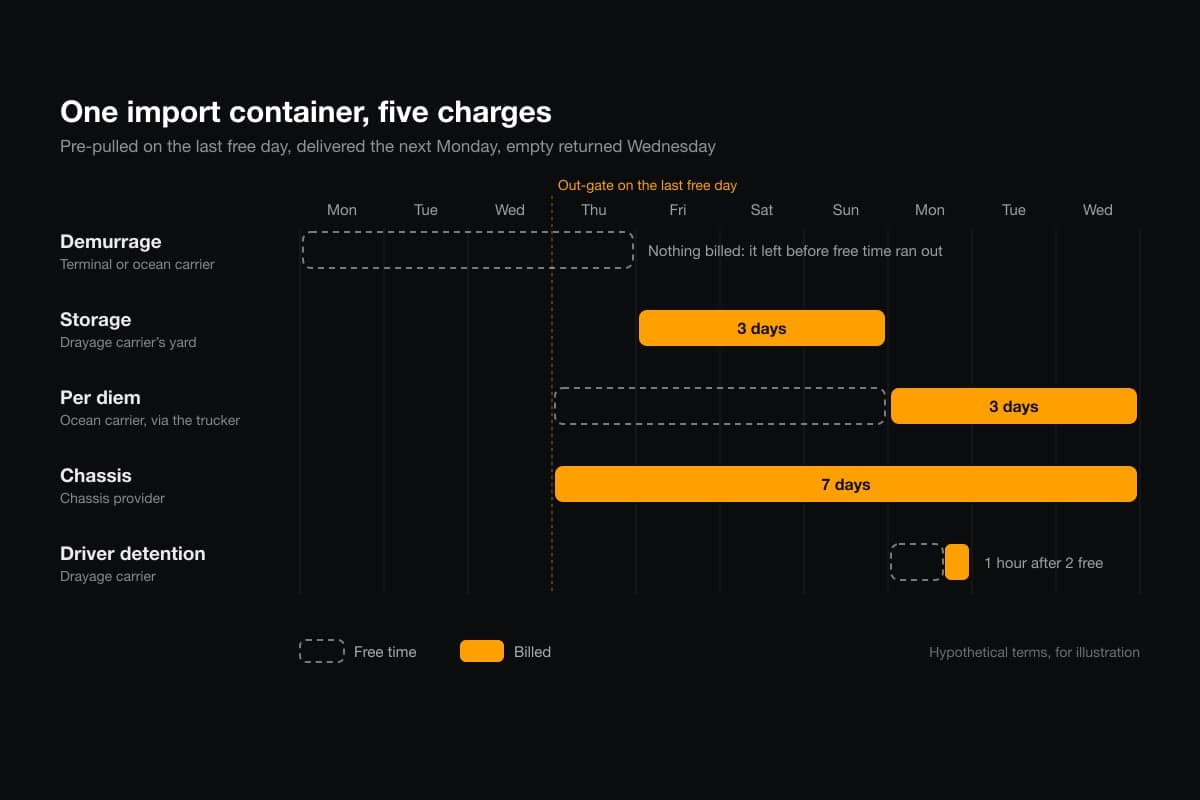
An import container sits at a Long Beach terminal past its last free day while the consignee's warehouse works through a backlog. By the time the empty is back, three invoices are on their way. The terminal or ocean carrier bills demurrage. The ocean carrier bills per diem to the trucker, who passes it on. And the trucker adds an hour of detention for the wait at the dock.
All three are charges for time, and two of them are sometimes called detention. That is why they get mixed up on quotes, rebilled to the wrong party or paid twice. Each one runs on its own clock, starts with a different event and comes from a different company.
Three charges, three clocks
Demurrage is charged while a loaded container stays inside the marine terminal or rail yard after its free time. The clock usually starts when the container is discharged and available for pickup, and it stops when the container leaves through the gate. The ocean carrier or the terminal bills it, normally to the importer or to the forwarder or broker acting for them.
Per diem is charged while the container is outside the terminal after its free days, until the empty is returned. The ocean carrier owns the container and sets the free days and the daily rate. In the US, equipment changes hands under the Uniform Intermodal Interchange and Facilities Access Agreement (UIIA), which covers most North American intermodal interchanges. Under the UIIA, per diem is billed to the motor carrier that took the container out, and per diem and container detention are the same charge.
Driver detention, also called waiting time, is the drayage carrier's own charge for keeping the truck and driver at a pickup or delivery site past the free time. Drayage rates often include one or two free hours, followed by an hourly rate.
Two more charges run alongside these. Chassis is billed per day from pickup until the chassis is returned, often with a minimum number of days. And when a container is pre-pulled to the carrier's yard, storage is billed per day while it waits there.
Why "detention" means two different things
In ocean shipping, detention is about equipment: the container is out of the terminal and not back yet. In trucking, detention is about labor: a driver is waiting at a dock. A single drayage move can carry both, from different companies, under the same word.
On quotes and invoices, name them separately. Call the ocean carrier's charge per diem, call the trucker's charge driver detention or waiting time, and state the free time for each.
Some ocean carriers also combine demurrage and detention into one allowance of free days that covers the container inside and outside the terminal. Read the carrier's tariff or the shipment's quote rather than assuming the two are counted separately.
Who pays, and how the charge reaches the customer
Demurrage normally lands on the cargo side. The terminal or ocean carrier invoices the importer, its customs broker or its forwarder, and a terminal can hold a container until the charge is paid. Truckers sometimes advance demurrage to get a container released and then rebill it at cost.
Per diem reaches the customer in two steps. The ocean carrier bills the motor carrier that interchanged the container. The motor carrier then rebills its customer, usually at cost, with the out-gate and in-gate receipts that show when the container left and came back. When the delay was the customer's, such as a warehouse that kept a dropped container for a week, the rebill is fair. When the delay was the trucker's, it is not.
Driver detention is billed by the drayage carrier to whoever booked the move. Its support is the arrival, check-in and departure times at the site.
A worked example
Consider a hypothetical 40-foot import moving from a Long Beach terminal to a warehouse in Ontario, California. The terms are made up for the example. Real ones come from the terminal, the ocean carrier's UIIA addendum and the drayage quote.
- The container is available on Monday, and the last free day is Thursday.
- The warehouse can't receive it until the following Monday. Left at the terminal, the container would run up four more days of demurrage, Friday through Monday, if weekends count.
- Instead, the trucker pre-pulls it on Thursday and holds it at its yard. That avoids demurrage but adds a pre-pull fee, three days of yard storage from Friday to Sunday, and starts the per diem and chassis clocks on Thursday.
- On Monday the container is delivered live. The appointment is at 8:00, unloading ends at 11:00, and the rate includes two free hours, so one hour of driver detention is billed.
- The empty goes back on Wednesday. With four free per diem days counted from Thursday's out-gate, Monday through Wednesday may be billed as three days, depending on how the ocean carrier counts the return day.
- The chassis was out from Thursday to Wednesday, about a week of chassis days.
The pre-pull didn't remove the cost of waiting for the warehouse. It moved it from demurrage into pre-pull, storage, chassis and per diem. Whether that trade saves money depends on the terminal's daily demurrage rate against the other charges, which is why each one needs its own line on the quote.
What the FMC billing rule requires
Since May 2024, a Federal Maritime Commission rule has set how ocean carriers and marine terminal operators bill demurrage and detention in the US. They must send the invoice within 30 days of the last day the charges were incurred, include the information needed to check it, such as the container number, the free time and the dates the charges ran, and give the billed party at least 30 days to ask for a waiver, reduction or refund.
In September 2025, a federal appeals court set aside the part of the rule that limited who could be billed, so the rule no longer settles whether the trucker or the cargo side receives the invoice. The rest of the rule still applies. Per diem billed under the UIIA also follows the UIIA's own billing and dispute process.
For anyone reviewing these invoices, the practical point is the same: keep the interchange receipts and the free-time terms with the shipment, and check the dates on each invoice against them.
How to quote these charges
A drayage quote should price what the trucker controls, starting with the line haul and the fuel surcharge, and state the terms for what it passes through:
- Driver detention: the free hours, the hourly rate and whether the clock starts at arrival or check-in.
- Chassis: the daily rate, the minimum days and a chassis split if the chassis is picked up somewhere else.
- Pre-pull: the flat fee, plus storage per day at the carrier's yard.
- Demurrage and per diem: billed at cost with backup, who is responsible once free time runs out, and whether the trucker will advance demurrage to release a container.
- Who tracks the last free day and the per diem free days, and who gets told when they are close.
A checklist before the container moves
- Do you know the last free day, and who set it?
- How many per diem free days does the ocean carrier allow, and from which event are they counted?
- Is the move live or drop, and how long will the receiver hold a dropped container?
- Will a pre-pull save money once storage, chassis and per diem are added?
- Are the driver detention free hours and the clock start written on the rate?
- Who receives the demurrage and per diem invoices, and who approves rebilling them?
- Are the out-gate and in-gate receipts saved with the shipment?
Keep each charge on its own line
Most disputes over these charges start with a quote that lumped them together or left them out. Price them separately, name the company that bills each one, and say who pays when free time runs out.
In BidSource, chassis, pre-pull, storage and waiting time are separate fees on each carrier's buy quote and each customer's sell quote, from the same catalog as the drayage fee glossary. Pricing rules set them by customer, carrier or lane, so every quote shows each charge instead of burying it in the rate.