Drayage
How the Drayage Fuel Surcharge Works, With DOE/EIA Diesel Tables
Most drayage rates add fuel as a percentage of the line haul, set by a table keyed to the weekly DOE/EIA diesel price. How the index, the table and the timing work, and what to agree before you compare quotes.
 Sam Kabab7 min read
Two carriers quote the same lane from the Port of Savannah to a warehouse in Atlanta. One offers $575 plus a 32% fuel surcharge. The other offers $620 with fuel included. The first looks cheaper until the fuel is added: 32% of $575 is $184, so it costs $759 in total, $139 more than the second.
Next month the first quote will move again, because 32% isn't fixed. It comes from a table tied to the weekly diesel price, and the table, the price it reads and the week it uses all decide what the shipper pays.
What a drayage fuel surcharge is
A fuel surcharge (FSC) passes changes in the diesel price through to the shipper without renegotiating the rate. In drayage it is usually a percentage of the line haul rather than a charge per mile. Port and rail moves are short, and much of the time goes to terminals and docks, so carriers price fuel against the move instead of the miles.
The percentage follows a published diesel price, most often the weekly average from the U.S. Energy Information Administration (EIA). Shippers and carriers often call it the DOE price, because EIA is part of the Department of Energy.
Where the diesel price comes from
EIA collects retail on-highway diesel prices from a sample of stations every Monday morning and publishes them that afternoon, or on Tuesday when Monday is a federal holiday. It publishes a U.S. average and regional averages:
- U.S. average
- East Coast (PADD 1), split into New England, Central Atlantic and Lower Atlantic
- Midwest (PADD 2)
- Gulf Coast (PADD 3)
- Rocky Mountain (PADD 4)
- West Coast (PADD 5), with California and West Coast less California shown separately
California's price often runs well above the U.S. average, so the same table gives a different percentage depending on which price it reads. Agree on the region, not just on "the DOE price."
How a fuel surcharge table works
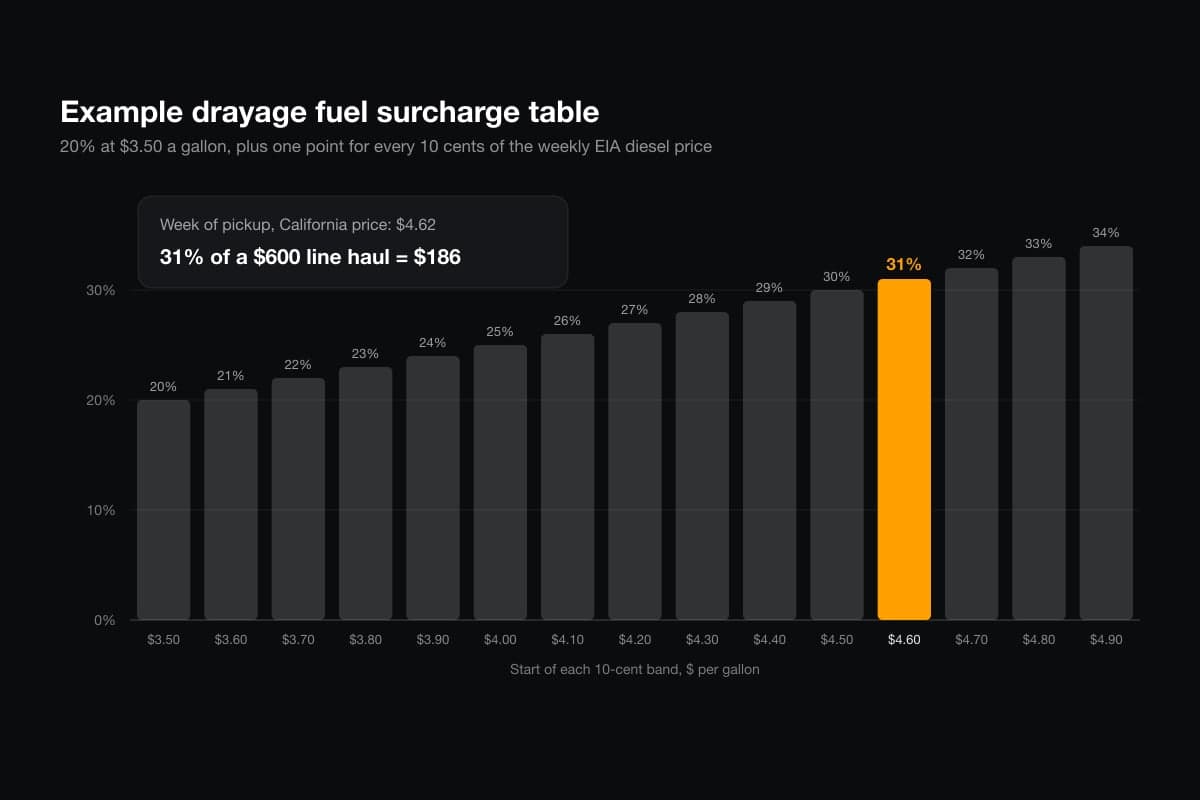
A fuel surcharge table lists diesel price bands and the percentage for each. Most start at a base price, below which the surcharge is zero or a set minimum, and add a fixed step for each band above it. The example table above charges 20% when diesel is between $3.50 and $3.59 a gallon and adds one percentage point for every 10 cents above that, so $4.00 to $4.09 is 25% and $4.60 to $4.69 is 31%.
Some carriers write the same thing as a formula: the base percentage, plus one step for each full increment above the base price. A table is easier to check line by line, and a formula keeps working when prices move past the end of the table.
Tables differ in their base price, the size of each band, the percentage per band and how far they run. EIA publishes prices to a tenth of a cent, so check how the table handles a price like $3.596. Most tables place it in the band it falls in, $3.50 to $3.59, rather than rounding it up.
A worked example
Consider a hypothetical move from the Port of Oakland to a warehouse in Sacramento. The carrier quotes a $600 line haul with fuel from the example table, read against EIA's California price.
- In the week of pickup, EIA publishes $4.62 for California. That falls in the $4.60 to $4.69 band, so the surcharge is 31%, or $186, and the move costs $786.
- Two weeks later, the price is $4.48. That falls in the $4.40 to $4.49 band, so the surcharge is 29%, or $174, and the same move costs $774.
The line haul never changed. Fuel moved the total by $12 in two weeks, and a customer who was quoted a single all-in price saw none of it.
Which week's price applies
The table only works if both sides agree which price applies to a move. Common choices are the price published in the week the container is picked up, the week it is delivered or the week the carrier invoices. Some contracts use the previous week's price, so the percentage is known before dispatch, or a monthly average to smooth out weekly swings.
A container that is pre-pulled one week and delivered the next can fall under two prices. Write the rule into the rate so the invoice doesn't depend on who reads it.
What the surcharge applies to
Most drayage fuel surcharges apply to the line haul only, not to accessorials such as chassis, storage or driver detention. Some carriers also apply fuel to extra moves that burn diesel, such as a pre-pull or a chassis split. Agree which charges carry fuel before you compare quotes, because 30% on a few accessorials adds up across a bid.
Comparing fuel in a drayage RFP
When carriers quote fuel differently, their line hauls can't be compared on their own. Ask every carrier for the same four things:
- The line haul without fuel
- Their fuel table, or a flat percentage if they won't use one
- The EIA region and the week rule
- Which charges the surcharge applies to
Then compare the totals at one reference price, such as the latest EIA price for the region the lanes will use. A carrier with a lower line haul and a steeper table can cost more when diesel rises, so check the totals at a higher and a lower price as well. The freight RFP guide covers the rest of the bid package, and RFP quoting shows how BidSource keeps carriers' answers comparable lane by lane.
Passing fuel through to your customer
Forwarders and brokers have two choices on the sell side. They can pass the carrier's surcharge through at the same percentage, so fuel moves in step on both sides, or charge the customer from their own table.
Passing the carrier's percentage through has a side effect worth knowing. If the sell line haul includes your margin and the fuel percentage is the same, the sell-side fuel dollars are higher than the buy-side ones, so you also earn margin on fuel. A table of your own protects you when carriers use different tables, but your margin on fuel then moves with the diesel price.
A fuel surcharge checklist
- Which EIA price does the rate use: the U.S. average or a region?
- Which week applies: pickup, delivery, invoice or a monthly average?
- What is in the table: the base price, the band size, the percentage per band and the rounding?
- Which charges carry fuel?
- Are quotes compared in total, at the same reference price?
- On the sell side, is fuel passed through at the carrier's percentage or priced from your own table?
How BidSource handles fuel
In BidSource, a fuel index pulls the EIA/DOE diesel price every week for the U.S. average, a PADD region or California, or uses a price you enter. A fuel rule sets the surcharge as a flat percentage or as bands that move with the index, and the surcharge is charged as a percentage of the base rate on buy and sell quotes. When one customer needs different fuel terms on one bid, that bid gets its own fuel schedule.
Pricing rules explains how fuel and the other drayage fees are set by customer, carrier or lane.