Drayage
Pre-Pull and Storage in Drayage: When They Apply and How to Price Them
A pre-pull moves a container to the trucker's yard before delivery, and yard storage is billed for each day it waits there. When each one applies, what carriers publish for them, and how to put both on a quote.
 Sam Kabab7 min read
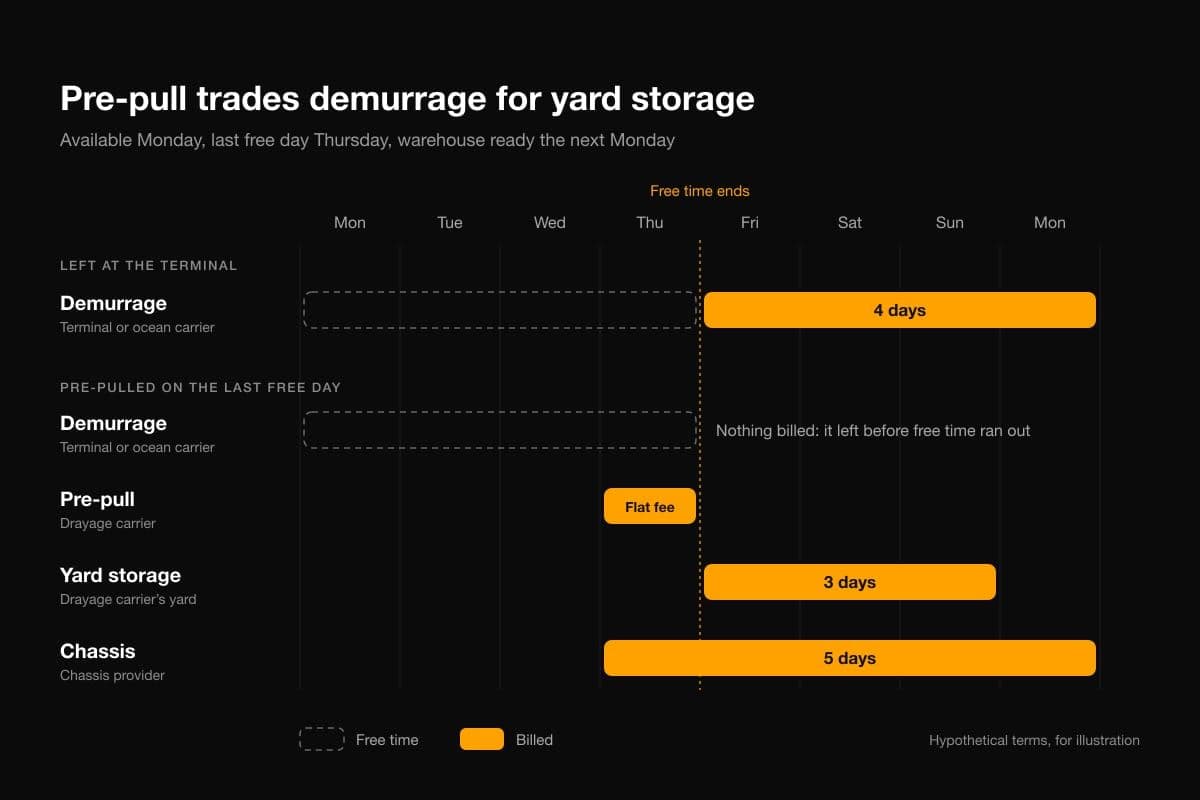
An import container is available at a Long Beach terminal on Monday, and its last free day is Thursday. The warehouse can't take it until the following Monday. Left at the terminal, it runs up four days of demurrage. Pulled out on Thursday and parked at the trucker's yard, it runs up a pre-pull fee, three days of yard storage and extra chassis days instead.
That trade is the whole decision behind a pre-pull. This guide covers when one applies, what drayage carriers publish for pre-pull and storage, and how to quote both so the customer sees the trade before it happens. It uses the same example as the guide to demurrage, detention and per diem.
What a pre-pull is
A pre-pull is a move from the terminal or rail ramp to the drayage carrier's yard ahead of the delivery day. The container waits there, usually still on its chassis, and goes out for delivery later. Carriers also call it a yard pull, a prep pull or a pull and hold.
It is billed as one flat charge per container. On most schedules, storage at the yard is a separate daily charge. A few carriers bundle some storage into the pre-pull: the IMC rate circular prices its pull and hold to include the move to the yard and three calendar days of storage. Two quotes with the same pre-pull price can cost different amounts once storage is added, so compare the two charges together.
When a pre-pull applies
- The last free day comes before the delivery appointment, because the receiver can't take the container in time or no terminal appointment, chassis or receiving slot is available.
- The delivery appointment is early in the morning, so the trucker pulls the container the day before to be at the door on time.
- An export's cutoff or earliest return date moves, and loaded export containers wait in the trucker's yard.
- The customer asks for an early pickup ahead of the delivery appointment.
The export case is common enough that the Federal Maritime Commission's shipper advisory committee raised it in a 2022 recommendation: when ocean carriers change return dates, exporters end up paying for yard storage, extra chassis days and extra moves.
A pre-pull should be something the customer chose. A pre-pull nobody asked for, on a container that could have been delivered inside its free time, is worth questioning before it is paid.
What carriers publish
These prices come from carriers' and forwarders' own published schedules, checked on October 25, 2026. Several schedules date from 2023 or earlier but are still the published rates.
- Rhenus, US, live page: pre-pull $150, storage $50 a day.
- Miami Container Trucking, PortMiami and Port Everglades, May 2025: pre-pull $150, storage $50 a day, first day free.
- All Points, Atlanta, January 2025: pre-pull $150, storage about $50 a day.
- Movargo, several US ports, 2025: pre-pull $200, storage priced case by case.
- STG Drayage, US, July 2023: pre-pull $150, or $206 to $226 at Norfolk and Seattle, storage $50 a day.
- IMC Companies, by region, 2020 to 2023: pull and hold $100 to $150 with three days of storage included, then $10 to $35 a day.
- States Logistics, Los Angeles and Long Beach, November 2023: pre-pull $100, storage $35 a day, first day free.
- Energy Transport Logistics, Los Angeles, March 2023: pre-pull $150, storage $50 a day.
- Easley Transportation, Memphis and Atlanta, schedule labeled 2018: pre-pull $125 plus fuel, storage $40 a day after two free days.
The schedules are from Rhenus, Miami Container Trucking, All Points, Movargo, STG Drayage, IMC's Pacific schedule, States Logistics, Energy Transport Logistics and Easley Transportation.
Across these schedules, a pre-pull runs $100 to $226 per container, and $150 is the most common price. Yard storage runs $10 to $50 a day, most often $50, and free days run from none to three. A shipper's own drayage RFP set the pre-pull at $100 in January 2025 (Sims Metal).
Ocean carriers that run the trucking themselves have charged more. Maersk's regional pre-pull fees ran $275 to $360 in 2020, plus $50 a day of storage, as Container News reported.
Guides that quote "typical" ranges run wider, from $75 to $300 for a pre-pull and $25 to $100 a day for storage. They describe the market rather than a price anyone has published, so ask each carrier for its own number.
A pre-pull doesn't stop every clock
Pulling the container stops demurrage, because demurrage only runs while the container is inside the terminal. Three other charges keep running or start:
- Per diem: the ocean carrier's clock for its container starts at the out-gate, so a pre-pull uses up per diem free days earlier.
- Chassis: the chassis is billed per day from pickup, usually $30 to $50 a day on the schedules above, often with a minimum number of days.
- Storage: the yard bills each day the container waits there, after any free days.
Some carriers state outright that their yard storage doesn't include the ocean carrier's per diem, as Energy Transport Logistics' schedule does. The guide to demurrage, detention and per diem explains who bills each charge.
A worked example
Take the container from the top of this guide. The terms below are made up for the example, using prices near the middle of the published ranges. Real ones come from the terminal, the ocean carrier and the drayage quote.
- Pre-pull on Thursday: $150.
- Yard storage Friday to Sunday: three days at $50, or $150.
- Chassis: picked up Thursday instead of Monday, so four extra days at $45, or $180.
- Added by the pre-pull: $480, before any per diem days it uses up.
Left at the terminal instead, the container would run up four days of demurrage, Friday through Monday, if the terminal counts weekends. At $150 a day that is $600, and the pre-pull saves $120. At $100 a day it is $400, and the pre-pull costs $80 more than waiting. A free storage day, or a carrier that bundles storage into the pre-pull, can tip the result the other way.
The answer changes with each terminal's tariff and each carrier's schedule. That is why the pre-pull and the storage need their own lines on the quote instead of being folded into the rate.
How to quote pre-pull and storage
- Pre-pull: a flat price per container, by port if the carrier prices ports differently. Say whether it includes the move to the yard and any free storage days.
- Storage: a price per day after a stated number of free days. Say whether the first day is free and whether days are calendar or business days.
- Fuel: say whether the fuel surcharge applies to the pre-pull, because some carriers add it.
- Approval: pre-pull only when the customer asks for it in writing, with the reason, such as a last free day before the appointment.
- Proof: keep the terminal out-gate time and the delivery time, so the storage days on the invoice can be checked.
- Chassis and per diem: price the chassis days, and say who pays per diem once its free days run out.
The free drayage RFP template lists Pre-Pull, Storage and Chassis as separate fees for every bidder to price, so the replies can be compared line by line.
Keep the trade visible
A pre-pull moves cost from one invoice to several. Quote each part on its own line and say who approved it, so the customer can see what the pre-pull saved, or didn't.
In BidSource, Pre-Pull and Storage are separate fees on each carrier's buy quote and each customer's sell quote, from the same catalog as the drayage fee glossary. Pricing rules set them by customer, carrier or lane, so every quote shows each charge instead of burying it in the rate.